This article is part of our ongoing blog series focused on specific vehicle modules and related systems. Our goal is to provide clear, practical information to help you better understand common issues, available solutions, and make informed decisions about your vehicle.
The Bosch 9.0 ABS Assembly
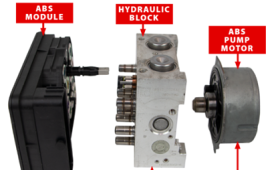
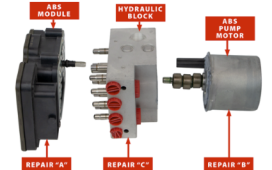
The Bosch 9.0 ABS system is comprised of three main components
- The ABS module
- The electric pump motor (AKA hydraulic pump)
- The hydraulic block
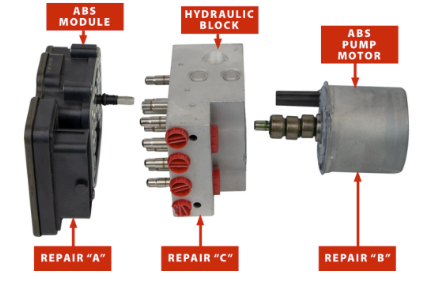
The Bosch 9.0 ABS system is a flexible and modular system which comes in several variations supporting a wide variety of powertrain technologies. The modular software architecture offers a significant reduction in development and validation costs to the automaker.
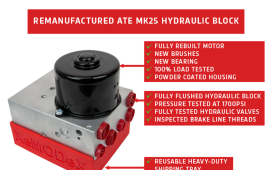
We have service options for all 3 components. See *HERE* for details.
Below is some technical information which may help you understand how the system works, and some tips to help prevent any future failures.
| YEAR | MAKE | MODEL |
| 2020 – 2024 | Ford | Transit 150 |
| 2020 – 2024 | Ford | Transit 250 |
| 2020 – 2024 | Ford | Transit 350 |
| 2020 – 2024 | Ford | Transit 350 HD |
Reference Numbers
LK4Z-2B373-A | MK4Z-2B373-A | MK4Z-2C219-A | MK4Z-2C219-B | MK4Z-2C219-C | MK4Z-2C219-D | MK4Z-2C219-E | MK4Z-2C219-F | NK4Z-2B373-A | NK4Z-2B373-A | NK4Z-2B373-B | NK4Z-2B373-C | NK4Z-2B373-D
And More
About Bosch 9.0 ABS System
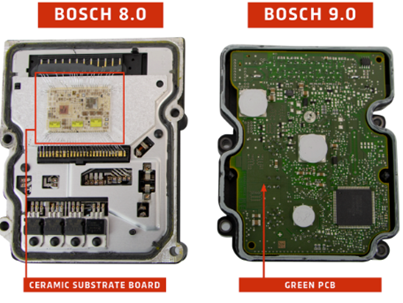
Bosch ABS modules version 5.3, 5.7, and 8.0 were based on a ceramic substrate board. This was a very complex design which enabled the board to be extremely compact. However, it had its flaws. The microscopic wire bands that connected the individual components were prone to damage under vibration. In version 9.0, they were replaced with a standard printed circuit board (PCB).
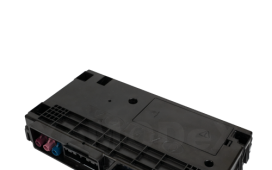
Bosch 9.0 ABS Module
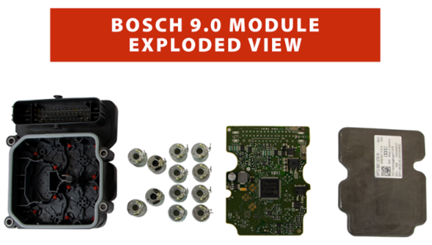
The Bosch 9.0 ABS module is not a rebuilder friendly design. The majority of the silicon chips are located on the opposite side of the board. This means the entire module must be fully dismantled to remove the printed circuit board (PCB). This is a delicate and time-consuming process that should only be performed by experienced professionals.
Bosch 9.0 ABS Electric Motor
The motor uses rare earth magnets that significantly improve power-to-weight ratio, reducing the motor weight by 30% compared to Bosch 8.0 version.
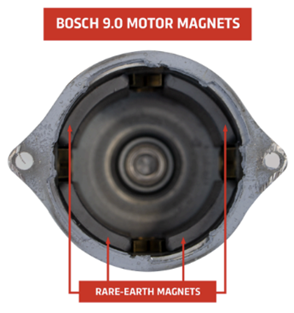
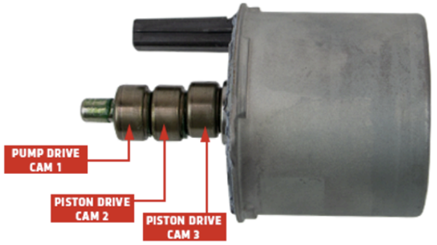
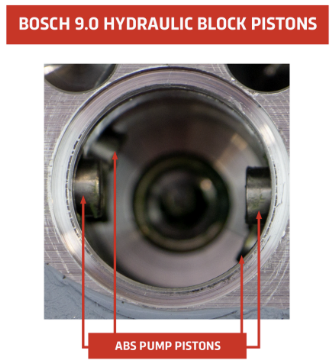
The stronger motor is now capable of driving six pistons instead of two in previous versions. There are three bearings that are mounted on the off-centered main motor shaft.
Bosch 9.0 Hydraulic Block
Each cam bearing drives a pair of pistons. The design allows the module to apply brake pressure to any caliper, regardless of the actual brake pedal position. This enables the auto-brake function capabilities as well as advanced stability control capabilities.
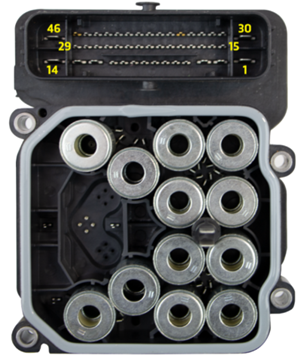
Bosch 9.0 ABS Module 44-Pin (Large Connector)
Note: The information in the table below is specific to the vehicle application listed at the top of the table. Other makes and models may have the same looking module, but the pinout will vary. This is a simplified diagram which only shows the “must-have” powers, grounds, and communication lines that are necessary for the ABS module to communicate with the vehicle.
| 2020-2024 Ford Transit | |||
| Pin # | Description | Measure with Ignition | Expected Value |
| 1 | Power Supply | ON | +12V |
| 30 | Power Supply | ON | +12V |
| 36 | Wake-up Power Supply | ON | +12V |
| 14 | Ground | OFF | Ground |
| 46 | Ground | OFF | Ground |
| 5 | CAN-H | ON | ≈ +2.4V |
| 19 | CAN-L | ON | ≈ +2.5V |
Tech Tips
Use DOT 4 Brake Fluid
We recommend DOT 4 brake fluid in all vehicles even if it had DOT 3 brake fluid originally. It’s well-known that DOT 4 has a higher boiling point and is suitable for heavy-duty use. It’s biggest advantage is that it degrades at a much slower rate. Therefore, it’s less corrosive to the 12 sensitive zinc-plated valves and springs inside the ABS hydraulic block.
Brake Fluid Replacement Intervals
Brake fluid should be flushed every two years, or 38,000 kilometers (24,000 miles).
Follow your manufacturers’ flushing procedures. In most cases a diagnostic tool is required to complete the procedure. One of the main reasons for that is that the ABS hydraulic block has several valves that are normally in a closed position. This means that old brake fluid will be trapped in some passages inside the block. The diagnostic tool has a function that activates these valves during the flushing procedure. Degraded brake fluid will damage these valves over time and is the main reason for soft brake pedal.
ABS Valve Caps are Sensitive to damage
Take care when handling the ABS hydraulic block. The valve protecting caps are made from a very thin stainless steel. Even a small dent will restrict the needle valve movement inside. To avoid damage during shipping, always ship the ABS hydraulic block with the module still attached to it.
Failure Symptoms
| Bosch 9.0 ABS Module Failure Symptoms | |||
| Symptom | Possible causes | Is the part repairable? | Repair Type |
| Lost Communication with the ABS Module | Check powers, grounds and communication lines to the ABS module. If it checks OK. There is an internal fault in the ABS module. | Yes * | Module (A) |
| Invalid Data Received from the ABS Module | Check powers, grounds and communication lines to the ABS module. If it checks OK. There is an internal fault in the ABS module. | Yes * | Module (A) |
| Left Front Wheel Speed Sensor-Circuit Low | Check wheel speed sensor, wiring, tone ring, wheel bearing for damage, wear, excessive air gap and contamination. Verify the correct tire size. Internal fault in the ABS module. | Yes * | Module (A) |
| Left Front Wheel Speed Sensor –Circuit High | Check wheel speed sensor, wiring, tone ring, wheel bearing for damage, wear, excessive air gap and contamination. Verify the correct tire size. Internal fault in the ABS module. | Yes * | Module (A) |
| Left Front Wheel Speed Sensor- Intermittent/Erratic | Check wheel speed sensor, wiring, tone ring, wheel bearing for damage, wear, excessive air gap and contamination. Verify the correct tire size. Internal fault in the ABS module. | Yes * | Module (A) |
| Left Front Wheel Speed Sensor-Correlation | Check wheel speed sensor, wiring, tone ring, wheel bearing for damage, wear, excessive air gap and contamination. Verify the correct tire size. Internal fault in the ABS module. | Yes * | Module (A) |
| Right Front Wheel Speed Sensor –Circuit Open | Check wheel speed sensor, wiring, tone ring, wheel bearing for damage, wear, excessive air gap and contamination. Verify the correct tire size. Internal fault in the ABS module. | Yes * | Module (A) |
| Right Front Wheel Speed Sensor- Range/Performance | Check wheel speed sensor, wiring, tone ring, wheel bearing for damage, wear, excessive air gap and contamination. Verify the correct tire size. Internal fault in the ABS module. | Yes * | Module (A) |
| Right Front Wheel Speed Sensor-Circuit Low | Check wheel speed sensor, wiring, tone ring, wheel bearing for damage, wear, excessive air gap and contamination. Verify the correct tire size. Internal fault in the ABS module. | Yes * | Module (A) |
| Right Front Wheel Speed Sensor –Circuit High | Check wheel speed sensor, wiring, tone ring, wheel bearing for damage, wear, excessive air gap and contamination. Verify the correct tire size. Internal fault in the ABS module. | Yes * | Module (A) |
| Right Front Wheel Speed Sensor- Intermittent/Erratic | Check wheel speed sensor, wiring, tone ring, wheel bearing for damage, wear, excessive air gap and contamination. Verify the correct tire size. Internal fault in the ABS module. | Yes * | Module (A) |
| Right Front Wheel Speed Sensor-Correlation | Check wheel speed sensor, wiring, tone ring, wheel bearing for damage, wear, excessive air gap and contamination. Verify the correct tire size. Internal fault in the ABS module. | Yes * | Module (A) |
| Left Rear Wheel Speed Sensor- Circuit Open | Check wheel speed sensor, wiring, tone ring, wheel bearing for damage, wear, excessive air gap and contamination. Verify the correct tire size. Internal fault in the ABS module. | Yes * | Module (A) |
| Left Rear Wheel Speed Sensor-Range/Performance | Check wheel speed sensor, wiring, tone ring, wheel bearing for damage, wear, excessive air gap and contamination. Verify the correct tire size. Internal fault in the ABS module. | Yes * | Module (A) |
| Left Rear Wheel Speed Sensor –Circuit Low | Check wheel speed sensor, wiring, tone ring, wheel bearing for damage, wear, excessive air gap and contamination. Verify the correct tire size. Internal fault in the ABS module. | Yes * | Module (A) |
| Left Rear Wheel Speed Sensor- Circuit High | Check wheel speed sensor, wiring, tone ring, wheel bearing for damage, wear, excessive air gap and contamination. Verify the correct tire size. Internal fault in the ABS module. | Yes * | Module (A) |
| Left Rear Speed Sensor-Intermittent/Erratic | Check wheel speed sensor, wiring, tone ring, wheel bearing for damage, wear, excessive air gap and contamination. Verify the correct tire size. Internal fault in the ABS module. | Yes * | Module (A) |
| Left Rear Wheel Speed Sensor- Correlation | Check wheel speed sensor, wiring, tone ring, wheel bearing for damage, wear, excessive air gap and contamination. Verify the correct tire size. Internal fault in the ABS module. | Yes * | Module (A) |
| Right Rear Wheel Speed Sensor-Circuit Open | Check wheel speed sensor, wiring, tone ring, wheel bearing for damage, wear, excessive air gap and contamination. Verify the correct tire size. Internal fault in the ABS module. | Yes * | Module (A) |
| Right Rear Wheel Speed Sensor –Range/Performance | Check wheel speed sensor, wiring, tone ring, wheel bearing for damage, wear, excessive air gap and contamination. Verify the correct tire size. Internal fault in the ABS module. | Yes * | Module (A) |
| Right Rear Wheel Speed Sensor- Circuit Low | Check wheel speed sensor, wiring, tone ring, wheel bearing for damage, wear, excessive air gap and contamination. Verify the correct tire size. Internal fault in the ABS module. | Yes * | Module (A) |
| Right Rear Speed Sensor-Circuit High | Check wheel speed sensor, wiring, tone ring, wheel bearing for damage, wear, excessive air gap and contamination. Verify the correct tire size. Internal fault in the ABS module. | Yes * | Module (A) |
| Right Rear Speed Sensor-Intermittent/Erratic | Check wheel speed sensor, wiring, tone ring, wheel bearing for damage, wear, excessive air gap and contamination. Verify the correct tire size. Internal fault in the ABS module. | Yes * | Module (A) |
| Right Rear Speed Sensor-Correlation | Check wheel speed sensor, wiring, tone ring, wheel bearing for damage, wear, excessive air gap and contamination. Verify the correct tire size. Internal fault in the ABS module. | Yes * | Module (A) |
| ABS Valves Supply Voltage-Circuit Open | Check powers, grounds and communication lines to the ABS module. If it checks OK. There is an internal fault in the ABS module. | Yes * | Module (A) |
| Electric Parking Brake is stuck, and it won’t release one or both rear wheels | Check the rear parking brake motors resistance; expected value is less than 3Ω. Check wiring and connectors. If all tests are good, there is an internal fault in the ABS module. | Yes * | Module (A) |
| Electric Parking Brake won’t engage one or both rear wheels | Check the rear parking brake motors resistance; expected value is less than 3Ω. Check wiring and connectors. If all tests are good, there is an internal fault in the ABS module. | Yes * | Module (A) |
| Bosch 9.0 ABS Module & Pump Failure Symptoms | ||||
| Symptom | Possible causes | Is the part repairable? | Repair Type | |
| Brake pressure sensor failure codes | Defective brake pressure sensor. The sensor is integral to the HCU hydraulic block. This sensor is not repairable. | No * | Please contact us. | |
| ABS Pump Motor Control: Circuit Short to Ground | Defective pump motor or internal fault in the ABS module. Send in both the hydraulic block (HCU) and module. | Yes * | Module & Pump (B) | |
| ABS Pump Motor Control: Circuit Short to Battery | Defective pump motor or internal fault in the ABS module. Send in both the hydraulic block (HCU) and module. | Yes * | Module & Pump (B) | |
| ABS Pump Motor Control: Circuit Open | Defective pump motor or internal fault in the ABS module. Send in both the hydraulic block (HCU) and module. | Yes * | Module & Pump (B) | |
| ABS Pump Motor Control: Actuator Stuck | Defective pump motor or internal fault in the ABS module. Send in both the hydraulic block (HCU) and module. | Yes * | Module & Pump (B) | |
| Bosch 9.0 Hydraulic Block Failure Symptoms | ||||
| Failure Symptom | Possible causes | Is the part repairable? | Repair Type | |
| The brake pedal goes to the floor. | This is not a very common failure in the Bosch 9.0 family of ABS units. Always check the master cylinder first. However, in is possible that the Normally Closed valve is stuck in an open position, inside the hydraulic block. | Yes * | Hydraulic Block (C) | |
| Soft, spongy brake pedal. | This is not a very common failure in the Bosch 9.0 family of ABS units. Always check the master cylinder first. However, in is possible that the Normally Closed valve is stuck in an open position, inside the hydraulic block. | Yes * | Hydraulic Block (C) | |
| Brakes cannot be bled. Brake fluid doesn’t flow out of one of the calipers. | This is caused by a faulty Normally Open valve stuck closed inside the hydraulic block. | Yes * | Hydraulic Block (C) | |
| Brakes are stuck in the applied position. The vehicle cannot be moved. | This is caused by a pair of faulty valves inside the hydraulic block. | Yes * | Hydraulic Block (C) | |
| Overheating, partially applied brakes. | This is caused by a pair of faulty valves inside the hydraulic block. | Yes * | Hydraulic Block (C) | |
| Vehicle pulls to one side when braking. | This is caused by a restriction inside the hydraulic block. | Yes * | Hydraulic Block (C) | |
| Brake pressure sensor failure codes. | The brake pressure sensor is an integral part of the hydraulic block. It is not replaceable or repairable. Please contact us for any available options. | No * | Please contact us for any available options. | |
*Almost all of these faults are repairable. However, there may be underlying issues that are impossible to repair. This includes water damage, burn damage, physical damage, or internal faults that can’t be accessed.
Visit www.xemodex.com to check out our products and services.