This article is part of our ongoing blog series focused on specific vehicle modules and related systems. Our goal is to provide clear, practical information to help you better understand common issues, available solutions, and make informed decisions about your vehicle.
The MK100 ABS Assembly
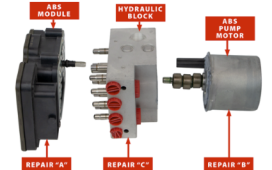
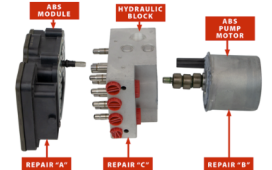
The MK100 ABS system is comprised of three main components
- The ABS module
- The electric pump motor (AKA hydraulic pump)
- The hydraulic block
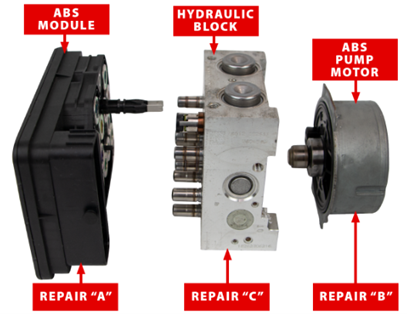
We have service options for all 3 components. See *HERE* <Link to Lincoln MK100 (46 pin) ABS Service Options Page> for details.
Below is some technical information which may help you understand how the system works, and some tips to help prevent any future failures.
Module Information
Application
| YEAR | MAKE | MODEL |
| 2017 – 2020 | Lincoln | Continental |
| 2021 – 2023 | Lincoln | Nautilus |
| 2015 – 2019 | Lincoln | MKC |
| 2016 – 2018 | Lincoln | MKX |
| 2012 – 2020 | Lincoln | MKZ |
Reference Numbers
DG9Z2C215D | DG9Z2C219D | DG9Z2C405A | DG9Z2C405D | DG9Z2C405G | DG9Z-2C405-J | EG9Z-2C215-A | EG9Z2C219B | EG9Z2C219C | EG9Z2C219D | EG9Z2C219E | EG9Z2C219F | EG9Z2C219G | EG9Z2C219H | EG9Z2C219J | EG9Z-2C219-K | EG9Z-2C219-L | EJ7Z-2C219-B | F2GZ-2C215-B | F2GZ-2C219-F | F2GZ-2C219-G | G3GZ2C215A | G3GZ2C215B | G3GZ-2C215-C | G3GZ-2C215-D | G3GZ-2C219-D | G3GZ-2C219-E | G3GZ-2C219-F | GJ7Z-2C215-A | GJ7Z-2C215-B | GJ7Z-2C219-A | K2GZ-2C286-C | KG9Z-2C215-B | KG9Z-2C215-C | KJ7Z-2C215-B | L2GZ-2C219-A | L2GZ-2C219-B | M2GZ-2C219-A
And More
About Continental ATE MK100 ABS System
In 2015 Continental introduced the next generation of their ABS System, the MK100, as a replacement to the MK61. The new gen is smaller and lighter but is also packed with new features. Such as electric parking brake integration, regenerative braking and scalable autonomous emergency braking, to name a few.
The MK100 ABS System comprises three main components: The ABS Module, Hydraulic Block, and the Electric Pump Motor. It is a flexible and modular system; it comes in several variants supporting a wide variety of powertrain technologies. The modular software architecture offers significant reduction in development and validation costs to the automaker.
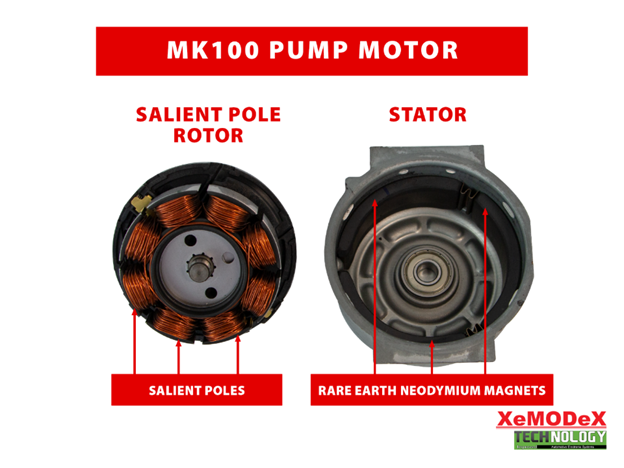
Engineers at Continental chose salient pole rotor design for the pump motor. Salient pole motors are typically used in low-speed applications (less than 1500 rpm), such as synchronous generators in hydroelectric power plants. A short axial length rotor design allows for smaller stator housing. Infact this motor is 38% shorter than previous MK61 generation.
ATE MK100 ABS Module
In 2015 Continental launched the MK100 ABS Module which replaced the outgoing MK61 design. The module is visibly smaller and lighter yet packed with a lot of new features, such as previously mentioned integrated electric parking brake control and autonomous braking.
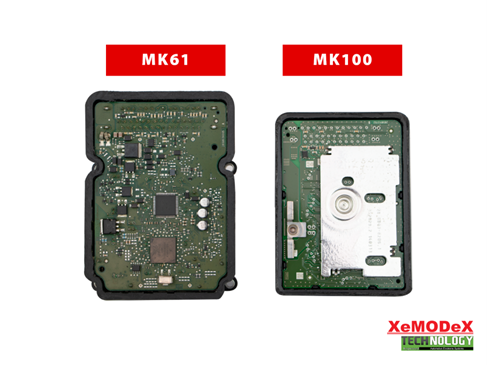
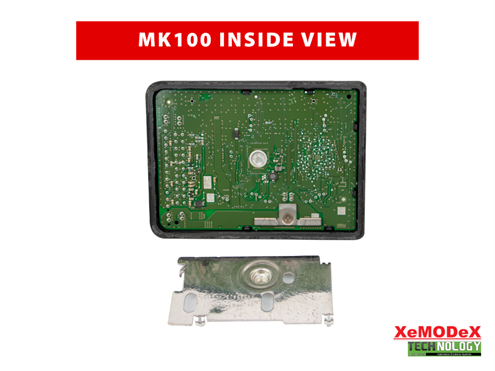
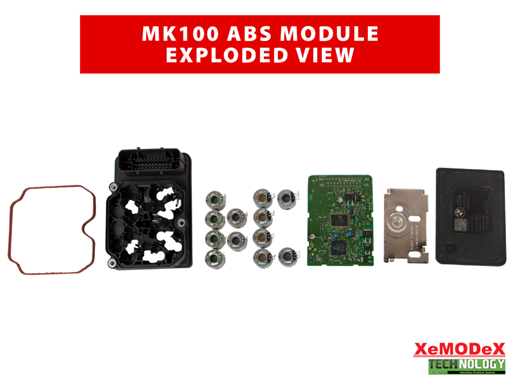
Unlike the MK61, the new MK100 is not a rebuilder-friendly module. All silicone chips are on the opposite side of the PCB. This means that the PCB needs to be removed from the module housing to service any one of them. The PCB is attached to housing via a minimum of 58 through-hole spreadable rivet pins. This is a delicate and time-consuming operation.
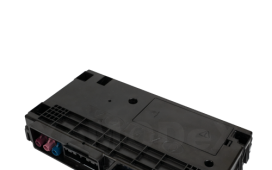
This is how the ABS Module looks like when it is fully disassembled and ready to be worked on.
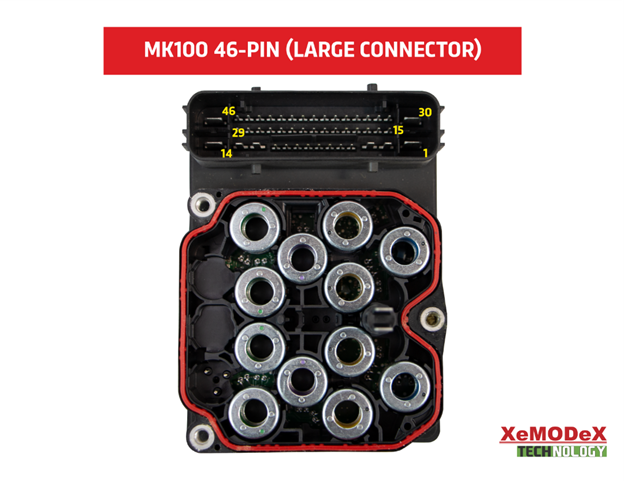
MK100 ABS Module 46-Pin (Large Connector)
Note: The information in the table below is specific to the vehicle application listed at the top of the table. Other makes and models may have the same looking module, but the pinout will vary. This is a simplified diagram which only shows the “must-have” powers, grounds, and communication lines that are necessary for the ABS module to communicate with the vehicle.
| 2020-2024 Ford Transit | |||
| Pin # | Description | Measure with Ignition | Expected Value |
| 1 | Power Supply | ON | +12V |
| 30 | Power Supply | ON | +12V |
| 35 | Wake-up Power Supply | ON | +12V |
| 14 | Ground | OFF | Ground |
| 43 | CAN-L | ON | ≈ +2.3V |
| 42 | CAN-H | ON | ≈ +2.4V |
Tech Tips
Use DOT 4 Brake Fluid
We recommend DOT 4 brake fluid in all vehicles even if it had DOT 3 brake fluid originally. It’s well-known that DOT 4 has a higher boiling point and is suitable for heavy-duty use. It’s biggest advantage is that it degrades at a much slower rate. Therefore, it’s less corrosive to the 12 sensitive zinc-plated valves and springs inside the ABS hydraulic block.
Brake Fluid Replacement Intervals
Brake fluid should be flushed every two years, or 38,000 kilometers (24,000 miles).
Follow your manufacturers’ flushing procedures. In most cases a diagnostic tool is required to complete the procedure. One of the main reasons for that is that the ABS hydraulic block has several valves that are normally in a closed position. This means that old brake fluid will be trapped in some passages inside the block. The diagnostic tool has a function that activates these valves during the flushing procedure. Degraded brake fluid will damage these valves over time and is the main reason for soft brake pedal.
ABS Valve Caps are Sensitive to damage
Take care when handling the ABS hydraulic block. The valve protecting caps are made from a very thin stainless steel. Even a small dent will restrict the needle valve movement inside. To avoid damage during shipping, always ship the ABS hydraulic block with the module still attached to it.
Failure Symptoms
| Lincoln MK100 ABS (46 pin) Module | |||
| Symptom | Possible causes | Is the part repairable? | Repair Type |
| Left Front Tone Wheel: Mechanical Failure | Check wheel speed sensor, wiring, tone ring, wheel bearing for damage, wear, excessive air gap and contamination. Verify the correct tire size. Internal defect in the ABS module. | Yes * | Module (A) |
| Left Front Wheel Speed Sensor: Mechanical Failure | Check wheel speed sensor, wiring, tone ring, wheel bearing for damage, wear, excessive air gap and contamination. Verify the correct tire size. Internal defect in the ABS module. | Yes * | Module (A) |
| Left Front Wheel Speed Sensor: Signal Invalid | Check wheel speed sensor, wiring, tone ring, wheel bearing for damage, wear, excessive air gap and contamination. Verify the correct tire size. Internal defect in the ABS module. | Yes * | Module (A) |
| Left Front Wheel Speed Sensor: Signal Erratic | Check wheel speed sensor, wiring, tone ring, wheel bearing for damage, wear, excessive air gap and contamination. Verify the correct tire size. Internal defect in the ABS module. | Yes * | Module (A) |
| Left Front Wheel Speed Sensor: Signal Plausibility Failure | Check wheel speed sensor, wiring, tone ring, wheel bearing for damage, wear, excessive air gap and contamination. Verify the correct tire size. Internal defect in the ABS module. | Yes * | Module (A) |
| Right Front Tone Wheel: Mechanical Failure | Check wheel speed sensor, wiring, tone ring, wheel bearing for damage, wear, excessive air gap and contamination. Verify the correct tire size. Internal defect in the ABS module. | Yes * | Module (A) |
| Right Front Wheel Speed Sensor: Mechanical Failure | Check wheel speed sensor, wiring, tone ring, wheel bearing for damage, wear, excessive air gap and contamination. Verify the correct tire size. Internal defect in the ABS module. | Yes * | Module (A) |
| Right Front Wheel Speed Sensor: Signal Invalid | Check wheel speed sensor, wiring, tone ring, wheel bearing for damage, wear, excessive air gap and contamination. Verify the correct tire size. Internal defect in the ABS module. | Yes * | Module (A) |
| Right Front Wheel Speed Sensor: Signal Erratic | Check wheel speed sensor, wiring, tone ring, wheel bearing for damage, wear, excessive air gap and contamination. Verify the correct tire size. Internal defect in the ABS module. | Yes * | Module (A) |
| Right Front Wheel Speed Sensor: Signal Plausibility Failure | Check wheel speed sensor, wiring, tone ring, wheel bearing for damage, wear, excessive air gap and contamination. Verify the correct tire size. Internal defect in the ABS module. | Yes * | Module (A) |
| Left Rear Tone Wheel: Mechanical Failure | Check wheel speed sensor, wiring, tone ring, wheel bearing for damage, wear, excessive air gap and contamination. Verify the correct tire size. Internal defect in the ABS module. | Yes * | Module (A) |
| Left Rear Wheel Speed Sensor: Mechanical Failure | Check wheel speed sensor, wiring, tone ring, wheel bearing for damage, wear, excessive air gap and contamination. Verify the correct tire size. Internal defect in the ABS module. | Yes * | Module (A) |
| Left Rear Wheel Speed Sensor: Signal Invalid | Check wheel speed sensor, wiring, tone ring, wheel bearing for damage, wear, excessive air gap and contamination. Verify the correct tire size. Internal defect in the ABS module. | Yes * | Module (A) |
| Left Rear Wheel Speed Sensor: Signal Erratic | Check wheel speed sensor, wiring, tone ring, wheel bearing for damage, wear, excessive air gap and contamination. Verify the correct tire size. Internal defect in the ABS module. | Yes * | Module (A) |
| Left Rear Wheel Speed Sensor: Signal Plausibility Failure | Check wheel speed sensor, wiring, tone ring, wheel bearing for damage, wear, excessive air gap and contamination. Verify the correct tire size. Internal defect in the ABS module. | Yes * | Module (A) |
| Right Rear Tone Wheel: Mechanical Failure | Check wheel speed sensor, wiring, tone ring, wheel bearing for damage, wear, excessive air gap and contamination. Verify the correct tire size. Internal defect in the ABS module. | Yes * | Module (A) |
| Right Rear Wheel Speed Sensor: Mechanical Failure | Check wheel speed sensor, wiring, tone ring, wheel bearing for damage, wear, excessive air gap and contamination. Verify the correct tire size. Internal defect in the ABS module. | Yes * | Module (A) |
| Right Rear Wheel Speed Sensor: Signal Invalid | Check wheel speed sensor, wiring, tone ring, wheel bearing for damage, wear, excessive air gap and contamination. Verify the correct tire size. Internal defect in the ABS module. | Yes * | Module (A) |
| Right Rear Wheel Speed Sensor: Signal Erratic | Check wheel speed sensor, wiring, tone ring, wheel bearing for damage, wear, excessive air gap and contamination. Verify the correct tire size. Internal defect in the ABS module. | Yes * | Module (A) |
| Right Rear Wheel Speed Sensor: Signal Plausibility Failure | Check wheel speed sensor, wiring, tone ring, wheel bearing for damage, wear, excessive air gap and contamination. Verify the correct tire size. Internal defect in the ABS module. | Yes * | Module (A) |
| TCS Control Channel “A” Valve 1: General Electrical Failure | Internal defect in the ABS module. | Yes * | Module (A) |
| TCS Control Channel “A” Valve 2: General Electrical Failure | Internal defect in the ABS module. | Yes * | Module (A) |
| TCS Control Channel “B” Valve 1: General Electrical Failure | Internal defect in the ABS module. | Yes * | Module (A) |
| TCS Control Channel “B” Valve 2: General Electrical Failure | Internal defect in the ABS module. | Yes * | Module (A) |
| Left Front Inlet Control: General Electrical Failure | Internal defect in the ABS module. | Yes * | Module (A) |
| Left Front Outlet Control: General Electrical Failure | Internal defect in the ABS module. | Yes * | Module (A) |
| Right Front Inlet Control: General Electrical Failure | Internal defect in the ABS module. | Yes * | Module (A) |
| Right Front Outlet Control: General Electrical Failure | Internal defect in the ABS module. | Yes * | Module (A) |
| Left Rear Inlet Control: General Electrical Failure | Internal defect in the ABS module. | Yes * | Module (A) |
| Left Rear Outlet Control: General Electrical Failure | Internal defect in the ABS module. | Yes * | Module (A) |
| Right Rear Inlet Control: General Electrical Failure | Internal defect in the ABS module. | Yes * | Module (A) |
| Right Rear Outlet Control: General Electrical Failure | Internal defect in the ABS module. | Yes * | Module (A) |
| Control Module: Internal Electronic Failure | Internal defect in the ABS module. | Yes * | Module (A) |
| Right Actuator, Left Actuator: Circuit Resistance Above Threshold | Check the rear parking brake motors resistance; expected value is less than 3Ω. Check wiring and connectors. If all tests are good, there is an internal defect in the ABS module. | Yes * | Module (A) |
| Right Actuator, Left Actuator: Actuator Stuck | Check the rear parking brake motors resistance; expected value is less than 3Ω. Check wiring and connectors. If all tests are good, there is an internal defect in the ABS module. | Yes * | Module (A) |
| Right Motor, Left Motor: Circuit Open | Check the rear parking brake motors resistance; expected value is less than 3Ω. Check wiring and connectors. If all tests are good, there is an internal defect in the ABS module. | Yes * | Module (A) |
| Right Motor, Left Motor: Circuit Voltage Out Of Range | Check the rear parking brake motors resistance; expected value is less than 3Ω. Check wiring and connectors. If all tests are good, there is an internal defect in the ABS module. | Yes * | Module (A) |
| Right Motor, Left Motor: Performance Or Incorrect Operation | Check the rear parking brake motors resistance; expected value is less than 3Ω. Check wiring and connectors. If all tests are good, there is an internal defect in the ABS module. | Yes * | Module (A) |
| Right Motor, Left Motor: Component Internal Failure | Check the rear parking brake motors resistance; expected value is less than 3Ω. Check wiring and connectors. If all tests are good, there is an internal defect in the ABS module. | Yes * | Module (A) |
| Lost Communication with the ABS Module | Test powers, grounds and communication lines to the module. If all good there is an internal defect in the ABS module. | Yes * | Module (A) |
*Almost all of these faults are repairable. However, there may be underlying issues that are impossible to repair. This includes water damage, burn damage, physical damage, or internal faults that can’t be accessed.
| Lincoln MK100 ABS (46 pin) Module & Pump | |||
| Symptom | Possible causes | Is the part repairable? | Repair Type |
| ABS Pump Motor Control: Circuit Short to Ground | Defective pump motor or internal fault in the ABS module. Send in both the hydraulic block (HCU) and module.
NOTE* IN ADDITION TO THE ABS PUMP REPAIR, THE ABS MODULE MUST BE REBUILT AS WELL. THE ABS PUMP IS CONTROLLED DIRECTLY BY THE ABS MODULE AND THE WORN-OUT MOTOR WILL WEAKEN OR SHORT INTERNAL DRIVER CIRCUIT. |
Yes * | Module & Pump (B) |
| ABS Pump Motor Control: Circuit Short to Battery | Defective pump motor or internal fault in the ABS module. Send in both the hydraulic block (HCU) and module.
NOTE* IN ADDITION TO THE ABS PUMP REPAIR, THE ABS MODULE MUST BE REBUILT AS WELL. THE ABS PUMP IS CONTROLLED DIRECTLY BY THE ABS MODULE AND THE WORN-OUT MOTOR WILL WEAKEN OR SHORT INTERNAL DRIVER CIRCUIT. |
Yes * | Module & Pump (B) |
| ABS Pump Motor Control: Circuit Open | Defective pump motor or internal fault in the ABS module. Send in both the hydraulic block (HCU) and module.
NOTE* IN ADDITION TO THE ABS PUMP REPAIR, THE ABS MODULE MUST BE REBUILT AS WELL. THE ABS PUMP IS CONTROLLED DIRECTLY BY THE ABS MODULE AND THE WORN-OUT MOTOR WILL WEAKEN OR SHORT INTERNAL DRIVER CIRCUIT. |
Yes * | Module & Pump (B) |
| ABS Pump Motor Control: Actuator Stuck | Defective pump motor or internal fault in the ABS module. Send in both the hydraulic block (HCU) and module.
NOTE* IN ADDITION TO THE ABS PUMP REPAIR, THE ABS MODULE MUST BE REBUILT AS WELL. THE ABS PUMP IS CONTROLLED DIRECTLY BY THE ABS MODULE AND THE WORN-OUT MOTOR WILL WEAKEN OR SHORT INTERNAL DRIVER CIRCUIT. |
Yes * | Module & Pump (B) |
| Brake Pressure Sensor ”A” | Defective brake pressure sensor. The sensor is integral to the HCU hydraulic block. This sensor is not repairable. | Not Repairable | |
*Almost all of these faults are repairable. However, there may be underlying issues that are impossible to repair. This includes water damage, burn damage, physical damage, or internal faults that can’t be accessed.
| Lincoln MK100 ABS (46 pin) Hydraulic Block | |||
| Symptom | Possible causes | Is the part repairable? | Repair Type |
| The brake pedal goes to the floor. | In the past, this failure was associated with a defective master cylinder. In the MK100 family of ABS units, this is caused by a Normally Closed valve stuck in an open position, inside the hydraulic block. | Yes * | Hydraulic Block (C) |
| Soft, spongy brake pedal. | In the past, this failure was associated with a defective master cylinder. In the MK100 family of ABS units, this is caused by a Normally Closed valve stuck in a partially- open position, inside the hydraulic block. | Yes * | Hydraulic Block (C) |
| Brakes cannot be bled. Brake fluid doesn’t flow out of one of the calipers. | This is caused by a faulty Normally Open valve stuck closed inside the hydraulic block. | Yes * | Hydraulic Block (C) |
| Brakes are stuck in the applied position. The vehicle cannot be moved. | This is caused by a pair of faulty valves inside the hydraulic block. | Yes * | Hydraulic Block (C) |
| Overheating, partially applied brakes. | This is caused by a pair of faulty valves inside the hydraulic block. | Yes * | Hydraulic Block (C) |
| Vehicle pulls to one side when braking. | This is caused by a restriction inside the hydraulic block. | Yes * | Hydraulic Block (C) |
| Brake pressure sensor failure codes. | The brake pressure sensor is an integral part of the hydraulic block. It is not replaceable or repairable. Please contact us for any available options. | Not Repairable | |
*Almost all of these faults are repairable. However, there may be underlying issues that are impossible to repair. This includes water damage, burn damage, physical damage, or internal faults that can’t be accessed.
Visit www.xemodex.com to check out our products and services.